
PRINTING
UNDER GLAZE TRANSFER PRINTING
Every transfer print was made from a hand engraved copperplate. The engraving process demanded extraordinarily high skills and each copperplate took on average six man weeks to complete. The most popular patterns needed numerous copperplates to be able to accommodate the necessary variety of shapes and sizes. In the early years cobalt blue was the only colour that could be used successfully.
The engraved part of the copperplate is charged with colour mixed with thick boiled oil and any surplus removed with a knife. A sheet of thin pottery tissue paper previously soaked with a solution of soap and water is placed on the copperplate and under a press and then drawn off bringing with it an inked impression from the copperplate. This tissue is then cut to size and laid by the transferrer onto the ware and rubbed with a small soaped flannel to fix it. The ware is then immersed in water and the paper washed away, the image remains unaffected. The oil is removed by placing the ware in a hardening kiln in order to destroy it. Underglaze printing in other colours was achieved in the 1820s with the introduction of chrome-based colours. With the advent of computer technology, the need for hand engraving diminished.
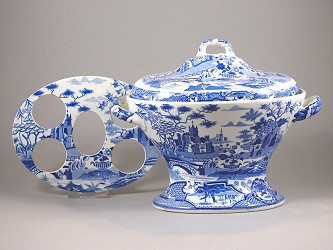
Spode Gothic Castle pattern printed in blue, c.1812
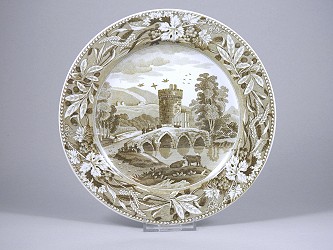
Spode Lucano pattern printed in brown, c.1820

Copeland Cairo pattern printed in red, c.1890
ON GLAZE BAT PRINTING
Bat printing is a process carried out on glaze and the engravings for this style are very fine, it first appeared in c.1800 in single colours and from c.1810 in gold. First the copperplate is charged with a fine boiled linseed oil and then cleaned so that the oil only remains in the engraving. A warm liquid gelatinous animal glue is poured into a flat dish and when cool the resulting sheets of jelly are abut 3mm thick. A section called a ‘bat’ is cut to suit the size of the engraving. Supported beneath by a cushion the bat is firmly pressed onto the charged copperplate. The small amount of oil left on the copper engraving is picked up on the flat surface of the glue ‘bat’ which is then pulled from the copperplate and placed on the cushion, oil side up. The item to be printed, is rolled onto the bat with even pressure to bring the oiled impression in contact with the surface of the item. When transfer is completed the ’bat’ is pulled away leaving a hardly visible amount of the oil on the surface of the item. Colouring in the form of a fine powder is dusted over the oily impression. This powder sticks and the item is then placed in a kiln for firing.
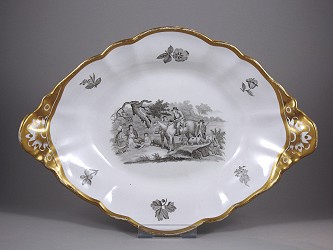
Spode bat prints in charcoal grey, c.1805
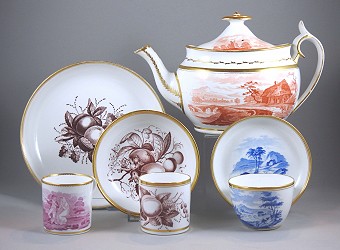
Spode bat prints in various colours, c.1808
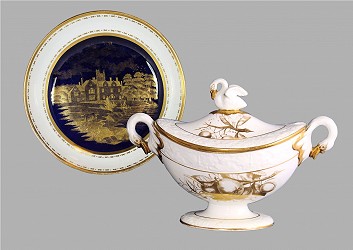
Spode bat prints in gold on cobalt blue ground and on white, c.1810-12
ON GLAZE PLUCK AND DUST PRINTING
1806 is the first recorded date at Spode for the ‘Pluck and Dust’ on glaze technique of printing in which the print was transferred by tissue, rather than by a gelatine 'bat', enabling larger prints and borders to be used. The hot press method using tissue paper transferred a stiff oil which contained no colour at all (except for a small percentage of Lamp Black [soot] which made the print slightly visible). The tissue was then rubbed down onto the glazed piece to transfer the pattern onto it. The tissue was then carefully plucked or pulled away leaving the sticky oily pattern behind. The oil was then dusted with finely ground enamel colour and the dust stuck to the oil. Any excess was cleaned off before the piece was fired at around 800°C in the enamel kiln, to make the pattern permanent.

Spode Red Plants and Insects patterns, c.1806
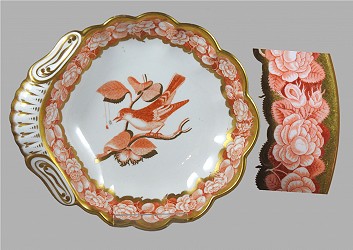
Spode Rose border, c.1806
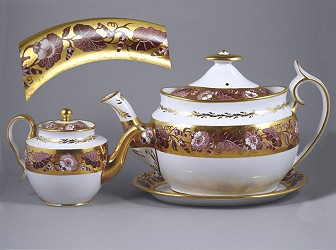
Spode Convolvulus border, c.1816
UNDER GLAZE PRINTING AND ON GLAZE PAINTING COMBINED
From about 1800 ‘print and paint’ was used at Spode, in which colours were painted within a printed outline. Whilst engraved copperplates enabled the production of large quantities of ceramics printed in monochrome, the technique also developed of engraving just the outline of patterns, which could then be filled in by hand in a variety of colours. This technique was less expensive and more standardised than freehand painting, and became the basis of much of Spode’s polychrome production until the 1950s when it was overtaken by lithographic printing

Spode black print overpainted, c.1820
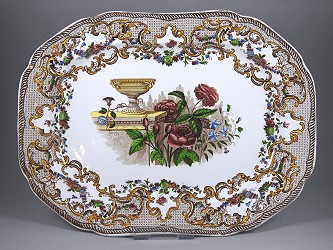
Copeland & Garret brown print overpainted, c.1833
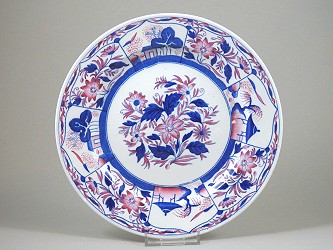
Spode blue print overpainted, c.1820