
COPELAND - SPODE 1900 ONWARDS
By 1900, the company had been owned and managed by the Copeland family for 67 years and continued for as long again. After the First World War, dinner and tea services ‘for best’ were popular and produced in huge quantities in different price ranges. A wide variety of transfer printed patterns was produced, often variants of patterns first produced in Josiah Spode the Second’s time and on a large scale.
The company also produced fine wares reflecting Art Deco and modernist styles, in the 1930s recruiting sculptors such as Erik Olsen from Norway who designed streamlined figures and ornamental ware finished in new glazes such as Onyx and Velamour.
In 1857 Copelands purchased the 18th century moulds made at the Chelsea and Derby factories and in the 1930s, the factory produced a range of figures, cast from and based on these Chelsea/Derby originals.
Spode produced the finest bone china body in the world. By maintaining the specialised rare skills of its employees, while at the same time investing in newer manufacturing processes, the factory kept the flexibility and capacity to make both larger quantities of mass-produced items and one-offs for special orders.
The company passed out of the hands of the Copeland family in 1966 and from that date underwent a number of changes in ownership, during which the business was merged with Royal Worcester.
The final decades of the 20th century saw immense changes in the methods of decorating ceramics which in turn made obsolete many of the traditional techniques which Spode had been been at the forefront. The highly skilled but slow and costly process of engraving was taken over by computerised design. Developments in lithographic printing meant that full colour images could be transferred onto wares and fired at a single firing.
Spode maintained small groups of specialist skilled workers right up to the end including engravers and hand decorators for bone china.
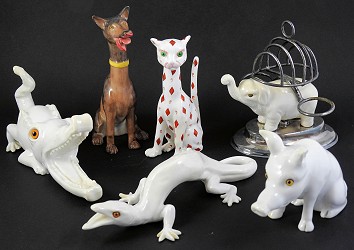
Copeland made animals of all types, even weird ones, c.1920

Spode made jewellery
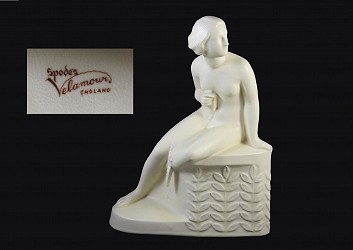
Sabrina, a stylized version by Eric Olsen of an earlier Copeland Parian figure, c.1930

Bone china plate with raised gilding on cobalt blue centre, pattern number 1/8663. Diameter 23.5cm, c.1907.

Bone china Nottingham shape dish, pattern number Y2613. Length 29cm, c. 1929.
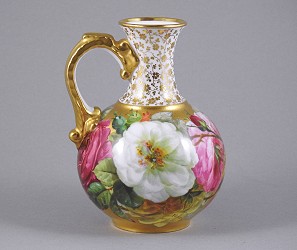
Bone china ewer hand painted and signed by Thomas Sadler. Height 13cm, c.1900.
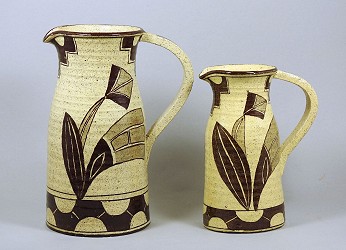
Jugs in a rough saggarmarl body, hand painted in brown, shape number K425, c. 1935.
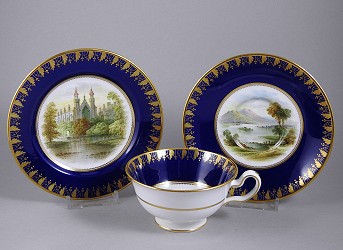
Bone china trio with hand painted centres in the style of Arthur Perry, pattern number R6719, c. 1926.

Bone china hand painted figure of St. George, model number F1235. Height 30.5cm, c.1967.

Earthenware moulded plate in Royal Jade glaze. Diameter 24cm, c.1930
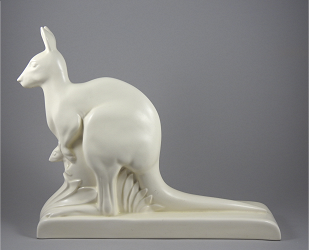
Figure of a kangaroo designed by Erik Olsen in a matt Velamour glaze, shape number K637. Length 36cm, c.1938.

Earthenware plate, diameter 27cm, c.1922

Spode produced a wide variety of bird figurines with realistic glass eyes, 1930s

Spode bone china plate printed and painted, pattern number Y8112, c.1966. Note the signature 'P. Hall' is printed.
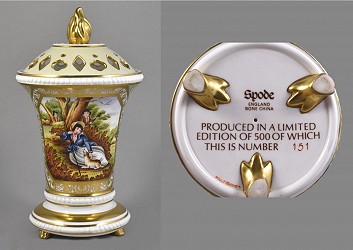
A bone china reproduction Pot Pourri vase and cover hand painted by Lyn Dumbleton in the Special Commission Studio, 1980s

Charming design for children c.1958

Example of work from the Special Commission Studio
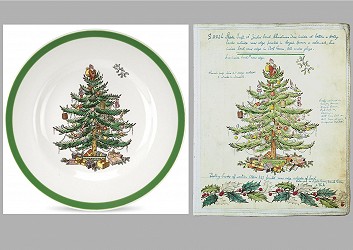
The iconic Christmas Tree pattern designed by Harold Holdway, 1938