
COPELAND 1847 - 1899
In 1846, William Taylor Copeland acquired the company outright. He was a classic Victorian gentleman industrialist, combining ownership of the factory with a career in politics and public life, as an MP and as Lord Mayor of London.
Under the Copelands, the factory vied with its neighbour Minton in making some of the most spectacular ceramics wares of the age. Gifted artists, such as Charles Ferdinand Hürten, were imported from continental factories and superb pieces were exhibited at the Great Exhibition of London 1851 and International Exhibitions in London 1862 and Paris 1878.
The range of wares made by Copelands during the Victorian period was enormous. Statues, busts, tiles, door furniture, toilet wares, special orders for Royalty and Regiments, table ware of all types, ornamental vases, plaques, hotel wares and souvenir wares were all made. Much of the production was exported to Europe, the Empire and in particular to the United States.
Between 1833 and 1900, around 35,000 new patterns were introduced – an average of ten new patterns every week. Versions of many of these continued into the 20th Century.

Copeland vase with hand painted flowers on a gold ground colour c.1883-90

Plate with a central scene hand painted by Lucien Besche
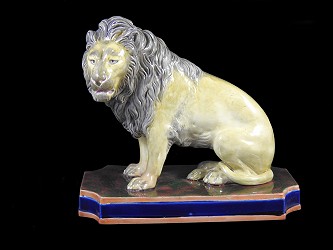
Copeland Majolica Lion, 1875
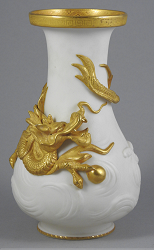
Parian Japanese Spill vase with applied solidly gilded dragon. Height 18cm, c.1870.
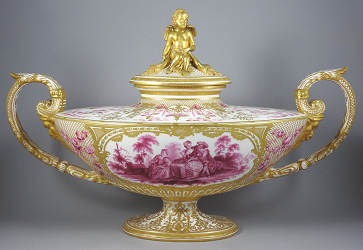
Bone china centrepiece with panels hand painted en camaieu with scenes after Watteau. Attributed to William Birbeck. Height 27cm x width 22cm, c.1862.
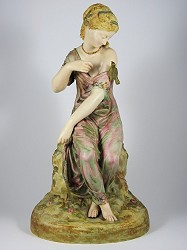
Parian statuette of Robinette tinted in colours and gold dust. Height 33cm, c.1896.

Bone china plate, centre hand painted with a hunting dog, pattern number 7109. Diameter 24.5cm, c.1847.
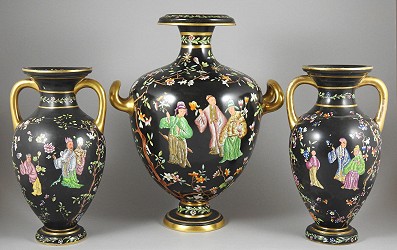
Three earthenware vases painted on a black ground with Chinese figures, pattern number 8119, c.1849
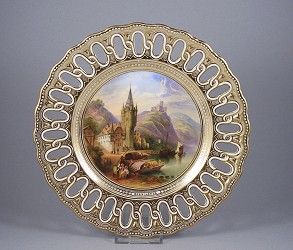
Bone china plate of Windsor shape hand painted with a view of Berncastel, pattern number D1559.
Diameter 22cm, c.1859.
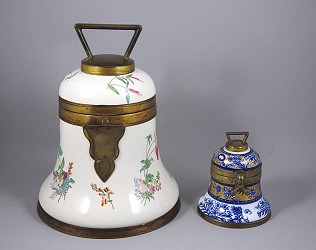
Large Bell shape earthenware biscuit jar shown alongside an inkwell of the same shape. Height of Biscuit jar 23cm, height of inkwell 11cm, c.1883.

Parian Madras shape ewer. Height 20.5cm, c.1860
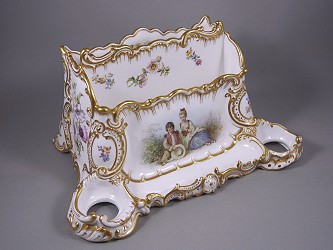
Bone china Sutherland shape desk stand, the front panel hand painted and signed by Samuel Alcock.
Length 29cm, c. 1885.

Tiny bone china Tea Caddy spoon, pattern number D. 1095, c.1859

Spoon warmers in the form of sea shells
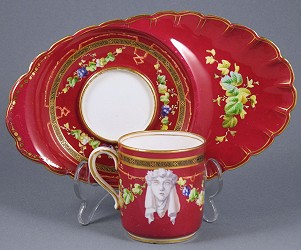
A Copeland bone china Tennis Set, pattern number D8276, c.1871 hand painted by Goldermann

Hand painted and jewelled dressing table tray by artist J. Wallace
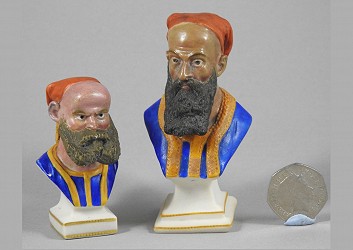
Rare Parian busts of Zouaves only 7cm and 9cm high, c.1855-60
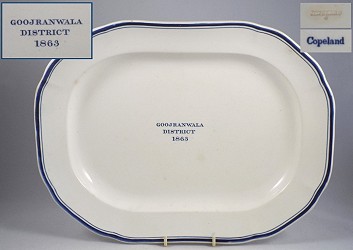
Serving platter for Indian regiment
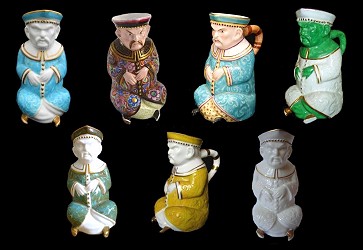
Mandarin toby jugs, c.1874
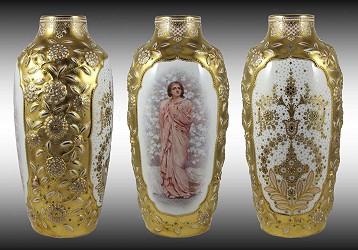
Vase with panel an allegory of Winter painted by Samuel Alcock, raised gilding and jewelling
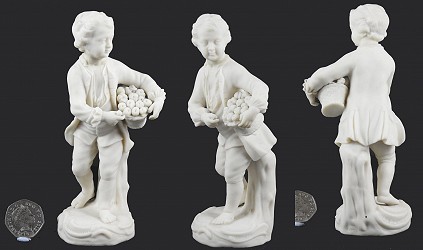
Small Parian statuette of a boy holding fruit basket